
LiveChat Review 2026: Features, Pricing, Ratings & Is It Worth It?

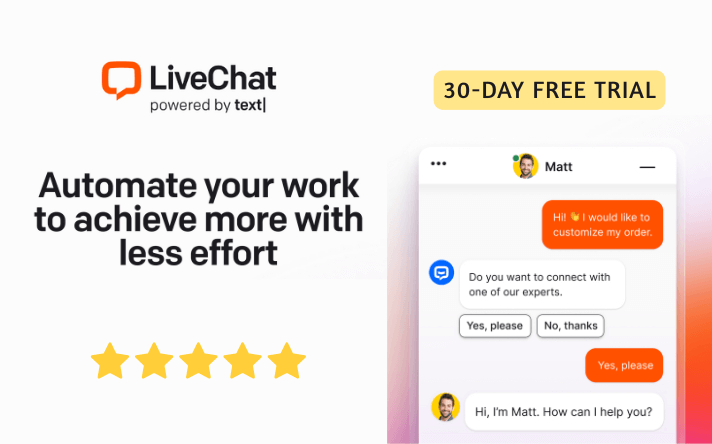
LiveChat is one of the most widely used live chat software solutions for businesses looking to improve customer support, sales engagement, and real-time communication. With customers increasingly expecting fast, personalized assistance, tools like LiveChat have become essential for modern businesses.
In this LiveChat review (2026 edition), we take a deep dive into LiveChat’s features, pricing, integrations, analytics, pros and cons, and overall value to help you decide whether it’s the right live chat and help desk solution for your business.
Overview: What Is LiveChat?
LiveChat is a customer communication platform developed by a Poland-based SaaS company founded in 2002. With more than two decades of industry experience, the company specializes in live chat software, help desk ticketing, and customer engagement analytics. LiveChat operates on a subscription-based model and is trusted by thousands of businesses worldwide to manage real-time conversations across websites, mobile apps, and multiple messaging channels.
In September 2023, the company formerly known as LiveChat Software S.A. rebranded as Text S.A. to reflect its expanded focus on AI-powered and multichannel communication solutions beyond the LiveChat product. Despite the name change, Text S.A. continues to own and operate LiveChat alongside other products such as ChatBot, HelpDesk, KnowledgeBase and OpenWidget. The company is publicly listed and serves over 35,000 customers globally.
Key Offerings
Text Inc. (formerly LiveChat Inc.) previously offered a unified 3-in-1 customer communication platform that combined live chat, ticketing, and analytics within a single product. This platform included real-time live chat for website visitors, a built-in help desk and ticketing system for managing customer issues across multiple channels, and analytics and reporting tools to track performance, engagement, and conversions.
Following the company’s rebranding and product realignment, the ticketing functionality that was once embedded directly within LiveChat has been transitioned into a separate, more advanced product called HelpDesk. While many businesses still use LiveChat as a central hub for customer service, sales, and support, chat and help desk capabilities are now offered as separate products within the same ecosystem.
How the Products Are Structured
- LiveChat focuses on real-time messaging, visitor tracking, and proactive chat engagement to support instant customer interactions.
- HelpDesk is designed for asynchronous support, enabling teams to manage emails, tickets, and complex or long-term customer cases.
Key Details About Text Inc.’s Services
- Separate Pricing: HelpDesk is a standalone product and is priced independently from LiveChat.
- Integrated Workflow: Despite being separate tools, LiveChat and HelpDesk integrate seamlessly, allowing chat conversations to be converted into tickets within the same interface.
Other Product Offerings
In addition to LiveChat and HelpDesk, Text Inc. provides several complementary tools to enhance customer engagement and support:
- ChatBot – AI-powered automation for faster, intelligent customer interactions.
- KnowledgeBase – A self-service platform for organizing FAQs and documentation.
- OpenWidget – A tool designed to convert website visitors into customers efficiently.
Who Is LiveChat Best For?
LiveChat is ideal for:
- SaaS companies
- E-commerce stores
- Customer support teams
- Sales-driven websites
- Enterprise customer service operations
It may not be suitable for starters or small businesses looking for a free forever plan, as LiveChat is a premium tool.
Benefits of Using Live Chat Software
1: Reduces Operating Costs
Live chat support is significantly more cost-effective than phone support. Studies show that live chat is 15–20% cheaper than call-based support, while allowing a single agent to handle multiple conversations simultaneously. This efficiency reduces staffing costs and improves productivity.
2: Increases Sales & Conversions
LiveChat enables businesses to engage visitors at the right moment and address questions or objections in real time. Industry research shows that adding live chat to a website can increase conversions by up to 20%, with some businesses reporting a return on investment as high as 300%.
Instant responses play a critical role in today’s fast-paced online environment. Many visitors are unwilling to wait for answers, and even short delays can lead to abandoned sessions and lost sales. Live chat helps eliminate this friction by allowing customers to connect directly with online agents and receive immediate assistance.

For sales teams, LiveChat is a highly effective tool for increasing conversions without overwhelming agents. By enabling meaningful, personalized conversations with visitors, businesses can generate more qualified leads, reduce drop-offs, and convert casual browsers into loyal customers.
3: Helps You Understand Customer Problems
LiveChat provides agents with real-time visibility into website visitors and their behavior, enabling faster and more informed responses. Features such as chat transcripts allow support teams to review previous conversations, helping agents deliver more personalized and effective assistance.

Customers increasingly prefer live chat over phone support because it is faster and more convenient. Studies show that over 50% of customers choose online chat before calling customer support, as it allows them to connect directly with an agent without waiting on hold. This growing preference highlights the rising demand for business live chat solutions.
Live chat also makes it easier for businesses to understand customer needs. Agents can see a real-time list of active visitors and engage with them proactively, improving issue resolution and overall customer experience. While managing diverse customer expectations can be challenging—especially without dedicated support agents—chat transcripts play a critical role by giving agents instant access to conversation history. This context helps them respond appropriately, avoid repeated questions, and handle difficult interactions more effectively based on prior engagements.
4: Improves Customer Loyalty
By providing a real-time view of active website visitors, LiveChat enables agents to engage proactively, resolve issues faster, and deliver a better overall customer experience. Managing diverse customer expectations can be challenging—particularly without dedicated support agents—but chat transcripts help bridge this gap by giving agents instant access to previous conversations. This context allows agents to respond more accurately, avoid asking repetitive questions, and handle complex or difficult interactions with greater confidence.
5: Gives You a Competitive Advantage
Despite its proven benefits, live chat adoption remains relatively low among businesses. By implementing LiveChat, companies can differentiate themselves from competitors, engage website visitors proactively, and capture leads while users are actively browsing. Industry research indicates that although live chat usage has grown in recent years, many organizations have yet to fully integrate it into their customer support strategy, with only a small percentage offering real-time chat as an alternative to traditional phone support.
These insights highlight a clear opportunity for businesses to gain a competitive advantage. LiveChat not only enables instant customer assistance but also strengthens the connection between sales teams and potential customers. By engaging visitors at the right moment, businesses can generate more qualified leads and significantly improve customer acquisition rates.
6: Powerful Reporting and Analytics
LiveChat provides comprehensive analytics that help businesses understand both customer behavior and team performance. With detailed reporting, you can track key metrics such as:
- Chat volume and peak activity hours
- Customer satisfaction scores
- Agent response and resolution times
- Visitor engagement and conversion data
These insights allow businesses to optimize staffing, improve workflows, and boost revenue by making data-driven decisions.
Beyond simply resolving visitor queries, LiveChat turns conversation data into actionable insights. The platform provides information on visitor engagement, resource utilization, and staffing forecasts, helping teams identify customer pain points, track the average time spent per chat, and even analyze visitor geolocation.
Additionally, LiveChat enables managers to monitor team performance in detail, including the number of chats and tickets handled, customer satisfaction ratings, average response times, and ticket resolution times. By leveraging this data, businesses can enhance support efficiency, deliver a better customer experience, and improve overall operational effectiveness.
LiveChat Integrations
LiveChat integrates seamlessly with 200+ third-party tools, including:
- CMS platforms: WordPress, Drupal
- CRM tools: Salesforce, HubSpot
- Analytics: Google Analytics
- Others: marketing & productivity tools
These integrations allow businesses to centralize customer data and improve operational efficiency without technical complexity.
Quick Glance: LiveChat Dashboard
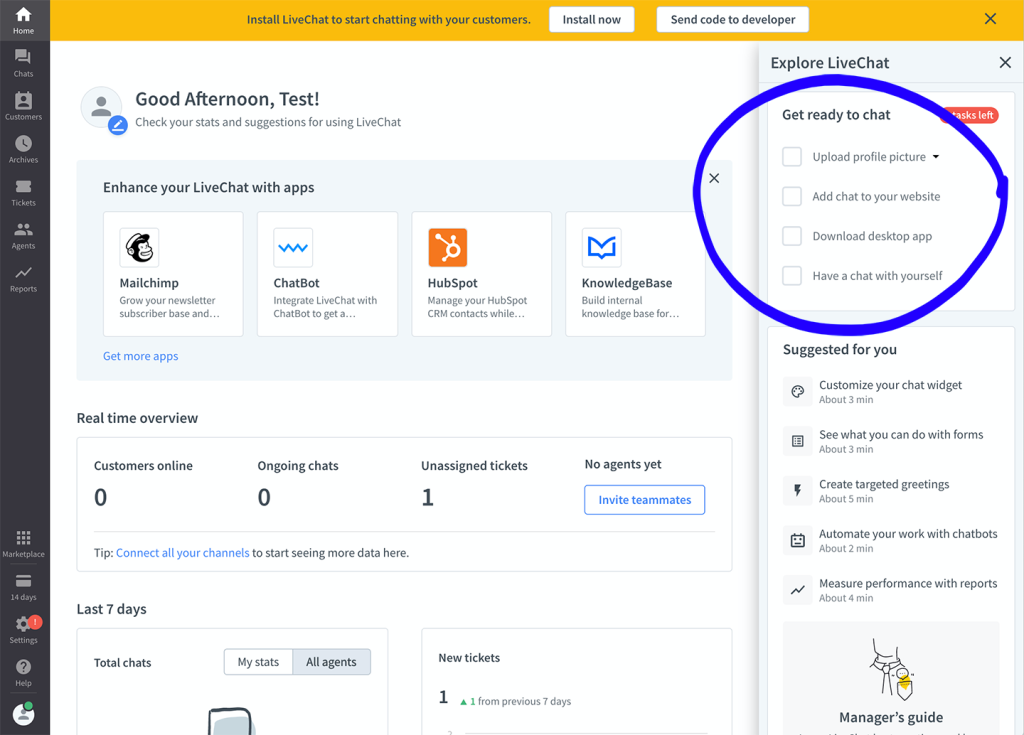
When you first log into LiveChat, the dashboard presents a clean, user-friendly navigation menu on the left-hand side, offering quick access to all essential features.
The Home section acts as your central hub, providing an overview of key metrics to help you monitor performance, track customer satisfaction, and stay aligned with your sales and support goals.
1) Performance Overview
Provides insights into essential metrics updated weekly:
- Total Chats: Track chat volume by time and day to plan staffing effectively.
- Satisfaction: See customer ratings for agents to identify top performers and mentoring opportunities.
- Efficiency: Monitor chats handled per agent per hour to evaluate productivity.
- Response Time: Measure how quickly agents respond, a crucial factor in customer satisfaction.
2) Real-Time Overview
Offers a live snapshot of current activity:
- Customers Online: Number of visitors on your website, with the option to invite them to chat.
- Ongoing Chats: Total active chats, helping assess workload against available agents.
- Unassigned Tickets: Tickets without an agent, indicating tasks that need attention.
- Logged-In Agents: Agents currently online, used to compare staffing against chat volume.
This section provides both historical and real-time insights, making it easier for owners and admins to optimize team performance and improve customer experience.
How to Add LiveChat to a Website (Step by Step)
Step 1: Install LiveChat on WordPress
Integrating LiveChat into a WordPress site is simple with the official LiveChat plugin, published by Text Inc. and freely available on WordPress.org.
To get started, log into your WordPress site with administrative access. Navigate to the Plugins section, click Add New, and search for the LiveChat plugin.
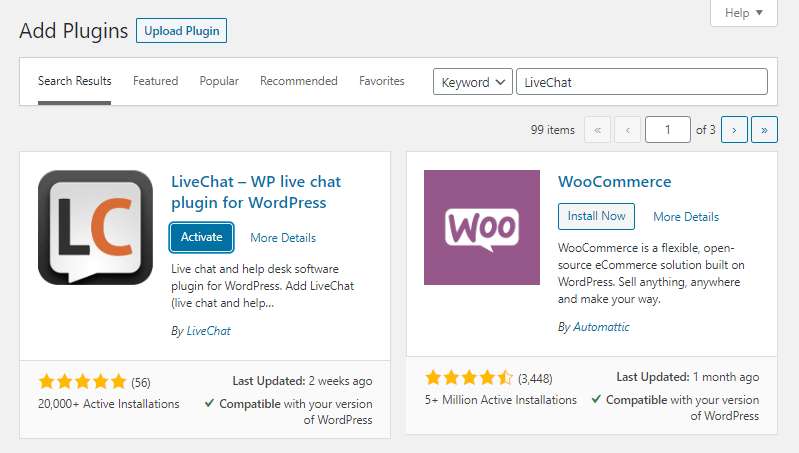
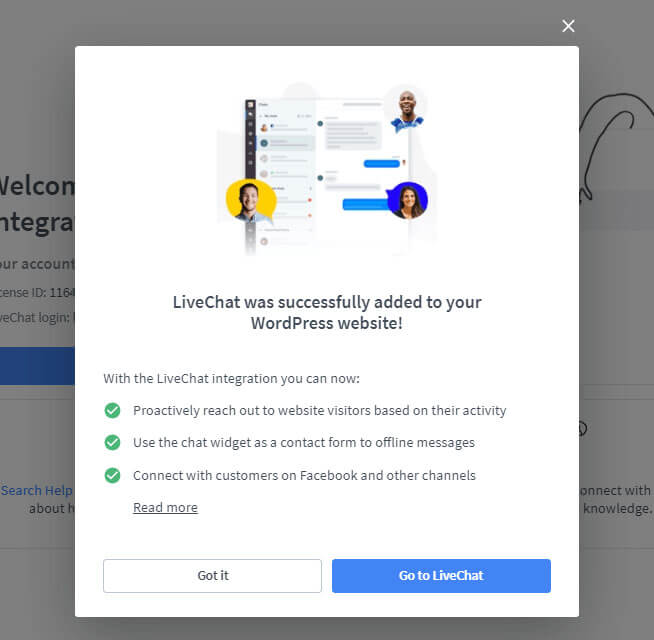
Once located, click Install and then Activate to add LiveChat to your website. The plugin will seamlessly integrate the chat widget, allowing you to start engaging with visitors immediately.
Step 2: Connect Your Website to LiveChat
After activating the plugin, you need to connect your WordPress site to your LiveChat account. To do this, go to the plugin’s Settings and click the “Connect with LiveChat” button.
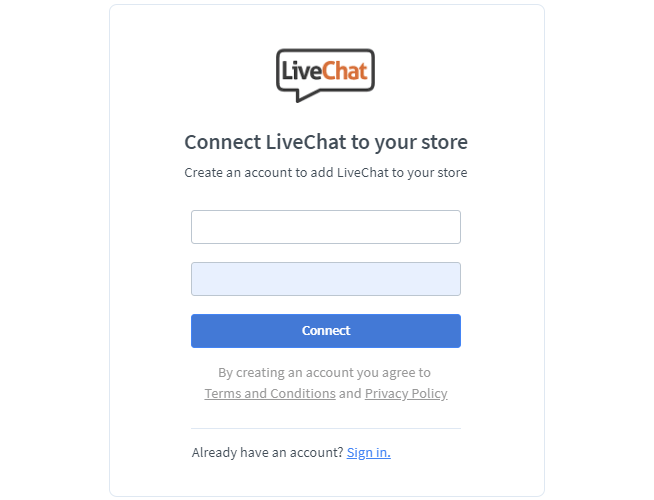
You will then have two options:
- Log in with your existing LiveChat account if you already have a membership or trial.
- Register to create a new account directly from within your WordPress site.
Once connected, a LiveChat widget will appear in the bottom-right corner of your website. If it doesn’t show immediately, simply refresh the page.
And that’s it—your WordPress site is now ready to start engaging visitors through LiveChat. In the next step, we’ll cover how to onboard your team members to get your live chat fully operational.
Step 3: Onboard Your Team
LiveChat offers a simple and intuitive interface that makes adding team members quick and easy. You can onboard your entire support team in just a few minutes by sending bulk invitations directly from the dashboard.

As your business grows, you can also send individual invitation links to add additional agents, ensuring seamless 24/7 customer support for your website visitors.
Step 4: Personalize Your LiveChat
Engage your visitors by initiating conversations with a personalized, automated welcome message. You can also upload a profile picture, which can make your chat appear more approachable and increase the likelihood that visitors will continue the conversation.
Tip: Keep your welcome message simple and friendly, creating the impression that visitors are speaking with a real person rather than a bot.
Step 5: Customize Your Chat Widget to Match Your Brand Look
LiveChat allows you to align your chat widget with your brand identity through a wide range of customization options. You can easily adjust colors to match your website’s theme, enhance brand recognition, and modify the widget’s behavior. For example, you can choose to disable the chat on mobile devices or enable the chat rating feature at the end of each conversation.
To customize your chat window, log into your LiveChat account and navigate to Settings → Chat Window → Customization. This will open the Chat Widget Configurator, where you can make all visual and functional adjustments in just a few clicks.
Appearance
In the Appearance tab, you can select from two themes for your chat widget: Light or Dark. Use the preview section on the right to toggle between themes and see how the widget will look on your website.
You can also choose how the chat window appears when minimized, with two options available: Bar or Bubble.
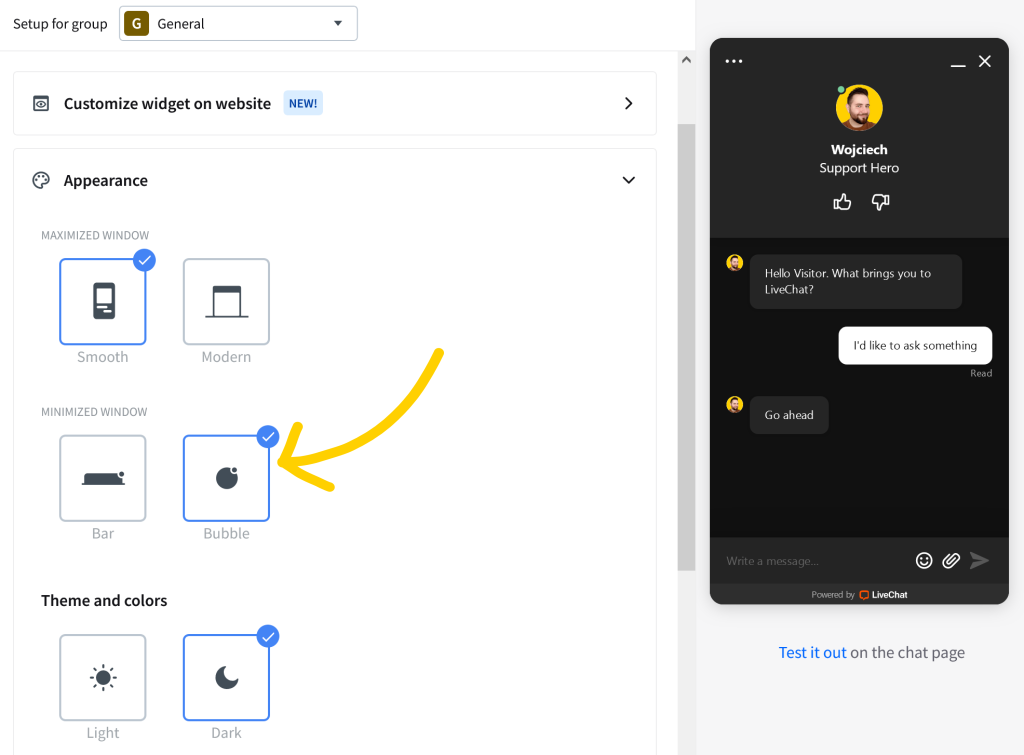
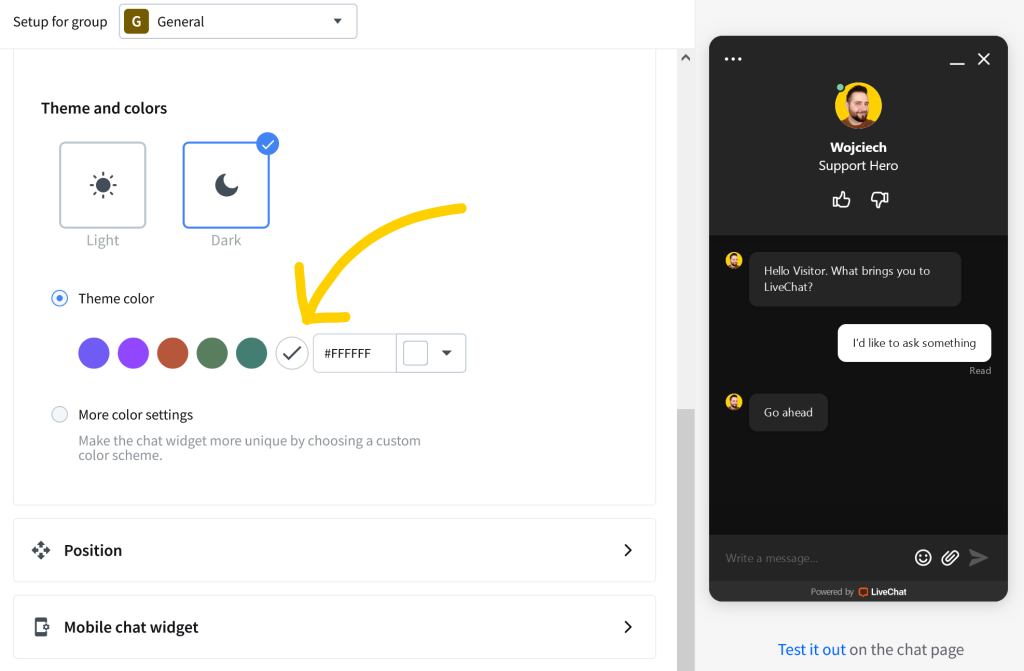
Next, customize the color scheme of your chat widget. You can either select from the pre-defined theme colors that match your website or brand, or create a custom color palette to perfectly align the chat window with your site’s design.
Position
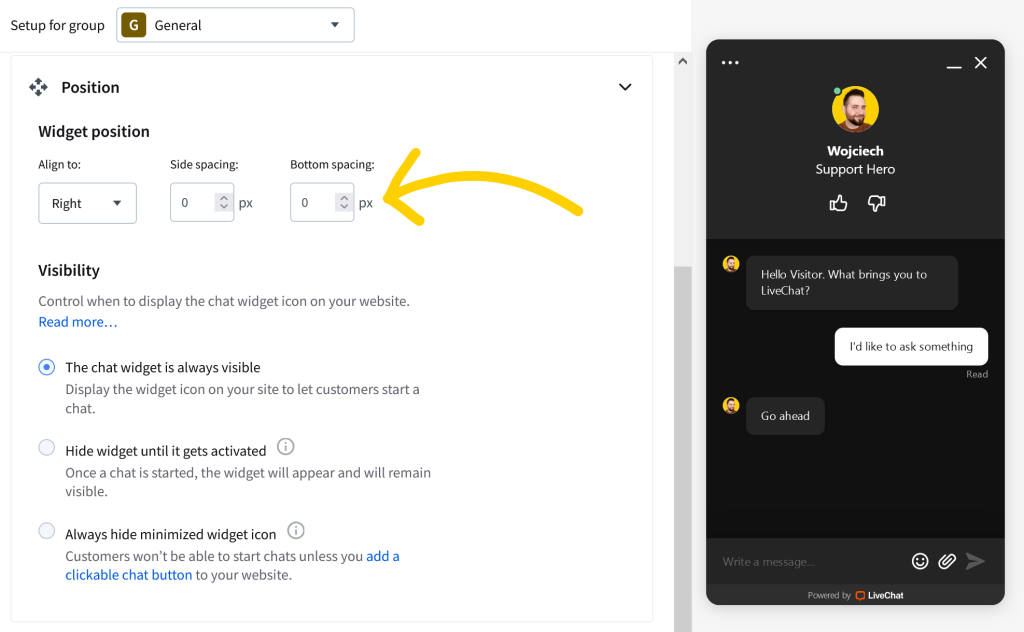
The Position tab allows you to control when and where the chat window appears on your website. By default, the LiveChat messenger is displayed in the bottom-right corner, but you can easily move it to the left side if preferred. You can also adjust the spacing of the chat window for a better fit on your pages.
Additionally, the tab provides three visibility options to manage how the chat widget icon is displayed on your website, giving you full control over its presence and accessibility for visitors.Under the Position tab, you can quickly control when and how the chat window will appear on your website pages.
Mobile Chat Widget
In this section, you can control the visibility of the LiveChat widget on mobile devices, with a simple toggle to enable or disable mobile chat.
When mobile chat is enabled, you can choose a unified experience across all platforms—desktop and mobile—so visitors can easily recognize the chat widget. Alternatively, you can customize the mobile chat appearance to optimize its look and functionality specifically for mobile users.
Additional Tweaks
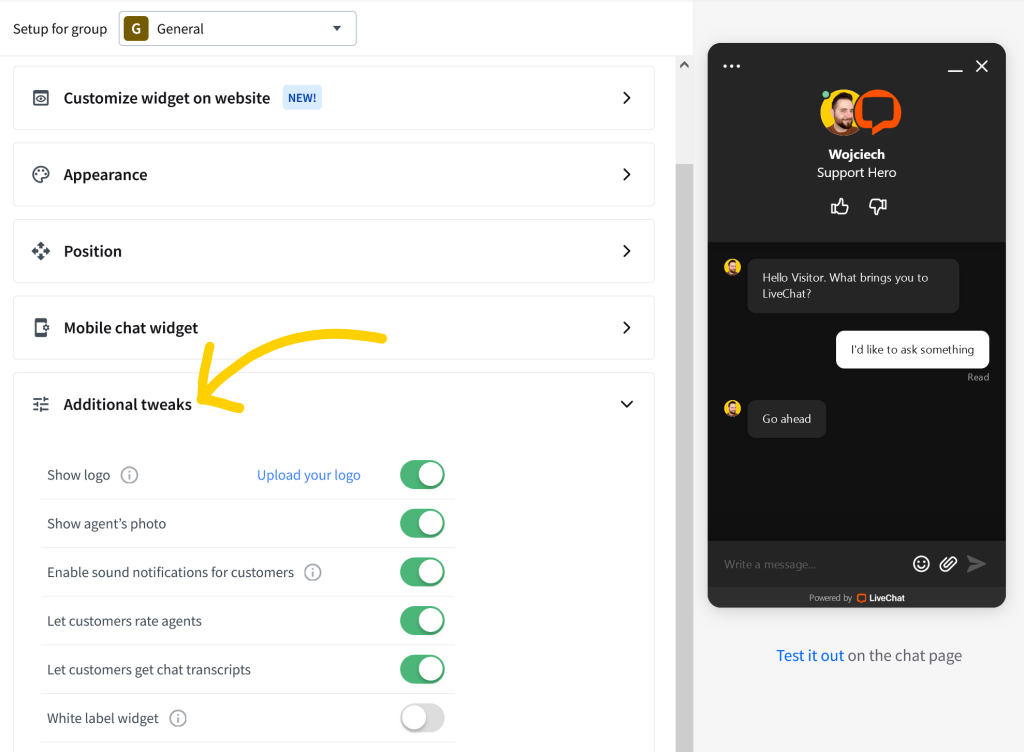
The Additional Tweaks tab lets you manage extra settings to enhance the chat experience. For example, you can allow visitors to download chat transcripts at the end of a conversation, hide the conversation rating button, and adjust other features to suit your website’s needs.
LiveChat Reports & Analytics
LiveChat provides detailed reports and analytics to help businesses monitor performance, optimize workflows, and make data-driven decisions.
Chat Reports
1. Total Chats Report
This report shows the number of chats handled by your team each day, allowing you to measure team workload and resource utilization. By identifying peak periods, you can allocate additional agents when needed to handle high chat volumes efficiently.
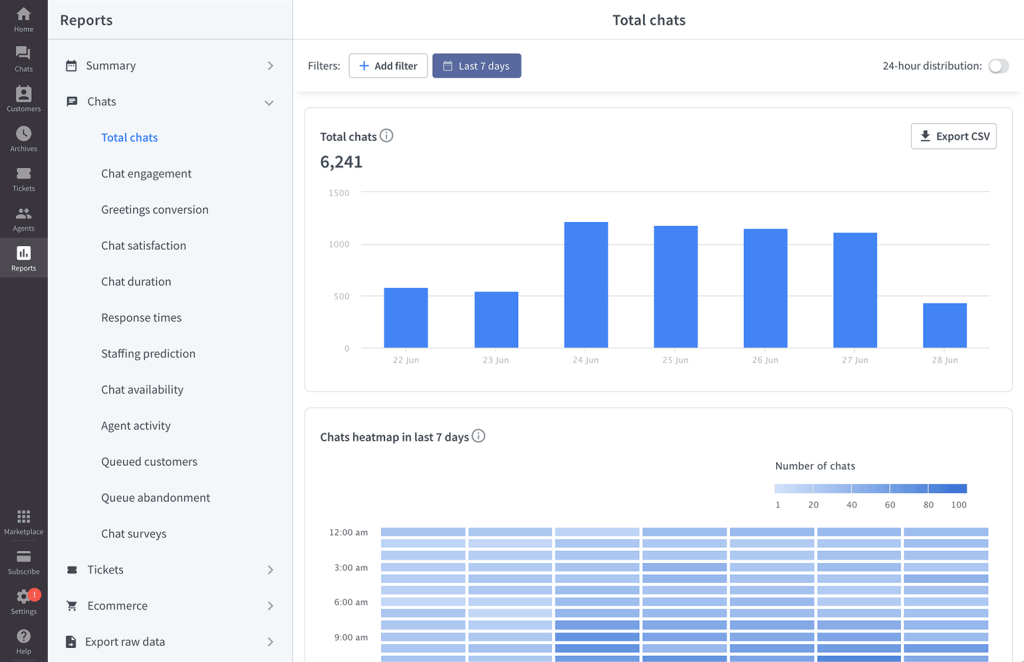
The Chats Heatmap is ideal for short-term shift planning, as it highlights the times of day when chat volume is highest and when agents are less busy. This insight helps you schedule staff more effectively and ensure adequate coverage during peak hours.
2. Missed Chats Report
Missed chats highlight opportunities that were not addressed, often caused by high visitor volume or limited agent availability. This report lets you track visitors who left without receiving support and identify patterns in missed interactions.
3. Greetings Conversion Report
Personalized greetings help capture visitor attention and improve customer experience. This report shows the performance of your chat greetings, including which messages lead to conversations and which may need optimization. LiveChat allows you to group greetings for easier analysis, helping you maximize engagement and lead generation.
4. Chat Satisfaction
Tracks customer satisfaction scores for chats handled by your team and individual agents. It’s useful for evaluating support quality and improving agent performance.
5. Chat Engagement Report
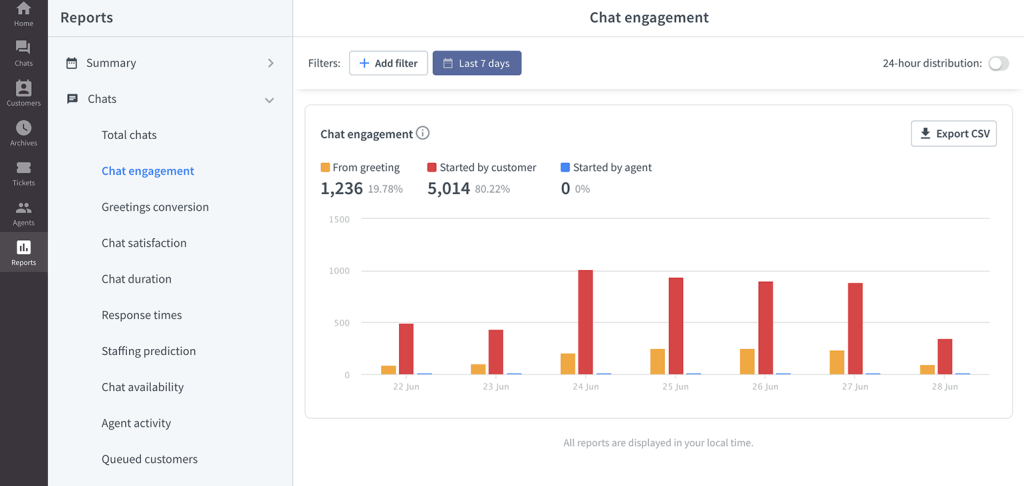
The Chat Engagement Report shows where chats are originating—whether from automated greetings, direct customer initiation, or agent-initiated conversations. Automated greetings are an effective way to encourage visitors to start a chat, increasing the chances of lead conversion. This report breaks down chats by the type of user who initiated them, helping you refine engagement strategies.
6. Chat Surveys
Collects and organizes feedback and information submitted by customers during chat surveys, giving you valuable insights into customer needs and preferences.
7. Chat Availability
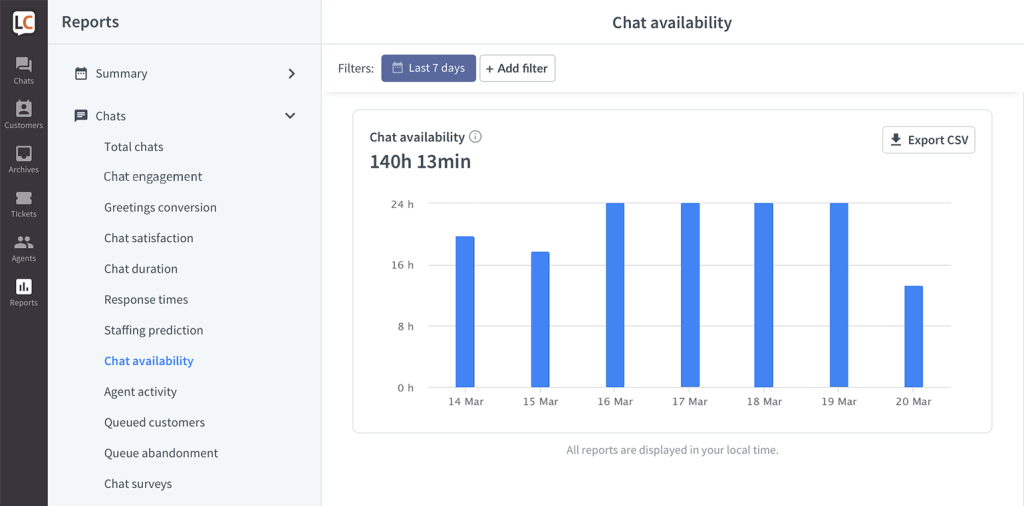
Displays how often your team is available to assist customers throughout the week, helping you optimize staffing and ensure consistent support coverage.
Agent Reports
1. Chat Duration
Tracks the average length of conversations handled by agents. This report helps assess whether agents are spending adequate time assisting customers and maintaining conversation quality.
2. Response Time
Measures how quickly agents respond to incoming chats. Fast response times are essential for customer satisfaction, and this report helps identify delays and opportunities to improve responsiveness.
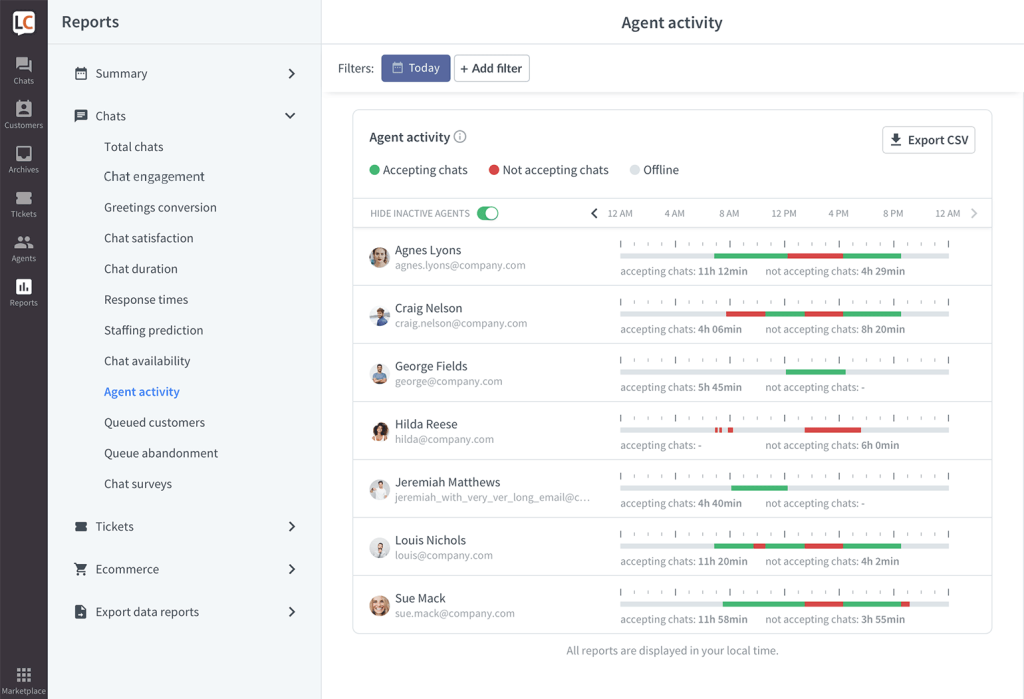
3. Agent Activity
Provides visibility into agent availability and status. You can see when agents are online, offline, or busy, ensuring you always know who is actively assisting customers.
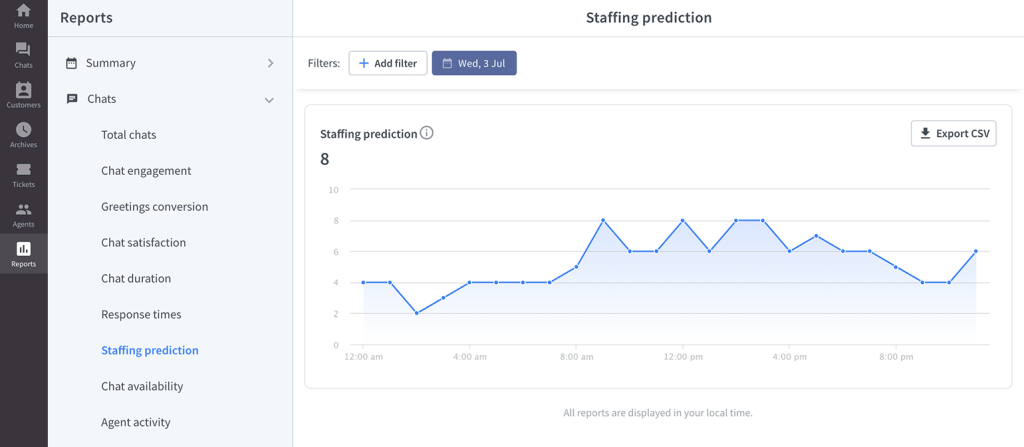
4. Staffing Prediction
Analyzes historical chat data to forecast staffing needs. This report helps you schedule the right number of agents for each shift, ensuring efficient coverage during peak and off-peak hours.
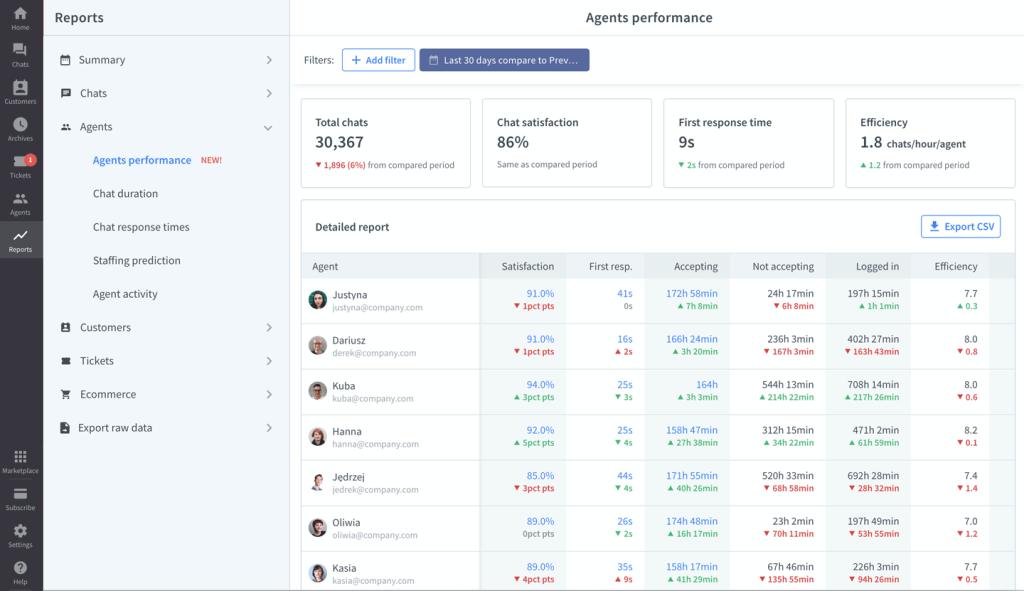
5. Agent Performance
Get a comprehensive view of how your team and individual agents are performing. All key metrics are consolidated into a single report, eliminating the need to switch between tabs or repeatedly adjust filters, and making it easy to evaluate productivity, efficiency, and overall support quality at a glance.
Customers
1. Queued Customers
Shows how many visitors are waiting in the chat queue before being connected to an agent. This report helps you identify high wait times and staffing gaps that may prevent timely customer support.
2. Abandoning Chats
Highlights conversations where visitors left before receiving a response. It helps you identify missed engagement opportunities and quantify potential leads lost due to slow replies or limited agent availability. The report also provides details such as which visitors exited the chat and how many completed pre-chat surveys, enabling you to spot coverage gaps and improve response times.
Ecommerce
1. Achieved Goals
The Achieved Goals Report shows how many chat interactions resulted in these outcomes, giving you actionable insights to refine workflows, boost engagement, and improve conversion rates. Goal performance can be reviewed daily, weekly, or quarterly to support informed, data-driven decisions.
2. Tracked Sales
The Tracked Sales Report provides a clear overview of the revenue generated from LiveChat conversations. It helps you assess the direct impact of live chat on sales performance, identify which interactions drive the most value, and measure overall contribution to business growth. This report is essential for monitoring sales metrics and optimizing the connection between customer support and revenue generation.
LiveChat Pricing (2026)
LiveChat does not offer a free plan but provides four paid tiers:
| Plan | Price (Per Agent / Month) | Best For |
| Starter | $16 | Freelancers & small teams |
| Team | $33 | Growing businesses |
| Business | $50 | SMBs |
| Enterprise | From $149 | Large organizations |
All plans include live chat and ticketing, but advanced features are available on higher tiers.
LiveChat Ratings (2026)
LiveChat scores highly across key evaluation areas, making it a strong choice for businesses of all sizes:
- Ease of Use: ⭐⭐⭐⭐⭐ (5/5) — Intuitive interface and quick setup
- Features: ⭐⭐⭐⭐☆ (4.5/5) — Robust live chat, analytics, and engagement tools
- Integrations: ⭐⭐⭐⭐⭐ (5/5) — Seamless connectivity with 200+ third-party apps
- Pricing: ⭐⭐⭐⭐☆ (4/5) — Competitive for its feature set, though not the cheapest option
- Customer Support: ⭐⭐⭐⭐⭐ (5/5) — Fast, knowledgeable, and reliable assistance
Overall Rating: ⭐⭐⭐⭐☆ 4.6 out of 5
LiveChat Pros and Cons
Pros
- Easy to install and use
- Powerful analytics and reporting
- 200+ integrations
- Enterprise-ready features
- Excellent customer support
Cons
- No free plan, but you get 30-day free trial
- Advanced features require higher plans
- Pricing may be high for small teams as services are sold separately
Support and Documentation
LiveChat offers extensive documentation with hundreds of well-organized help articles. Support is available via live chat, email, and ticketing, with fast and knowledgeable responses.
Final Verdict: Is LiveChat Worth It?
LiveChat is a reliable, feature-rich live chat and customer support platform designed for businesses that prioritize real-time engagement and data-driven decision-making. While it’s more expensive than some alternatives, its performance, integrations, analytics, and scalability make it one of the best live chat software solutions available in 2026.
If you’re looking for a professional live chat tool that improves customer experience and boosts conversions, LiveChat is well worth considering.
Have you used LiveChat before? Share your experience and rating in the comments below.
Disclaimer: This post may include affiliate links. If you click one of them, we may receive a small commission at no extra cost to you. Thank you for your support.